Mastering Basic & Advanced Knife Skills
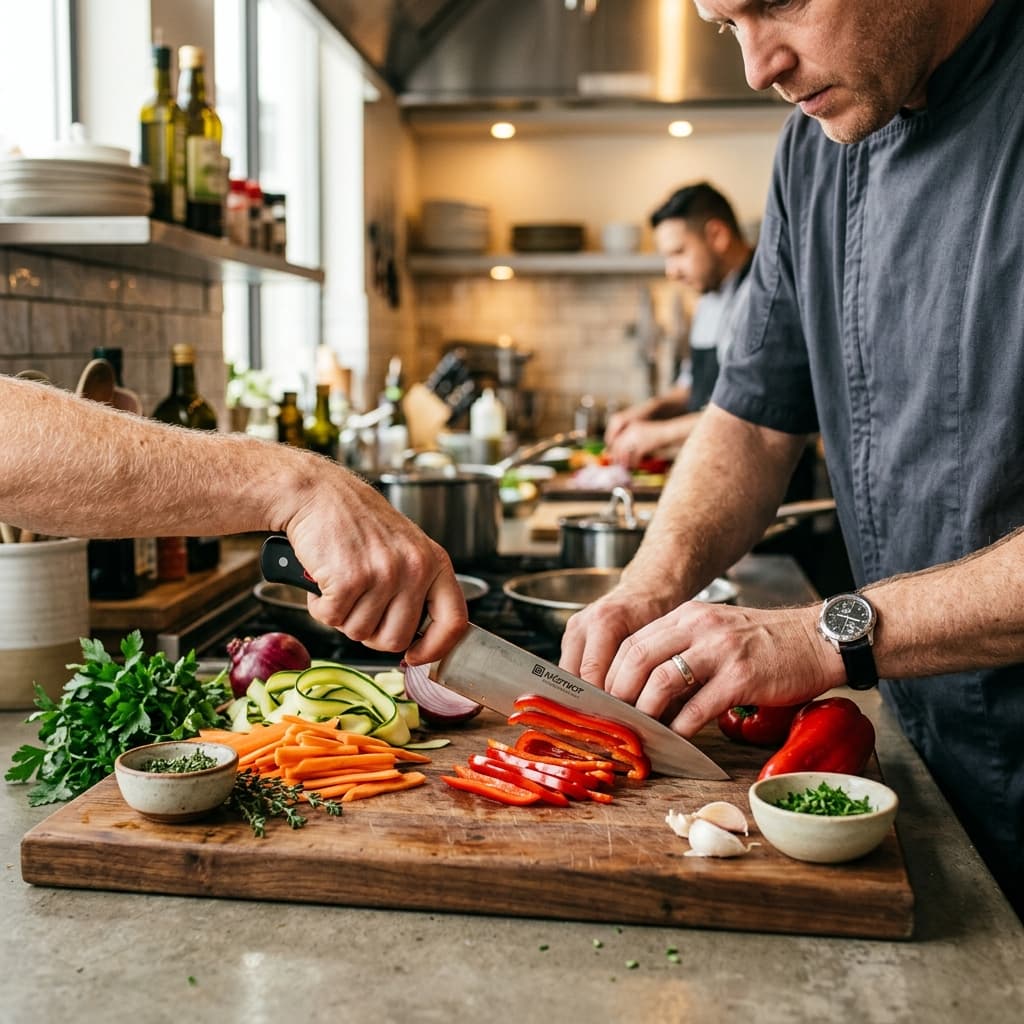
The Claw Grip
The most important technique to learn is the 'claw grip'. Curl the fingers of your non-dominant hand inward like a claw and use your knuckles to guide the knife blade. This protects your fingertips from being cut.
The Rocking Motion
Keep the tip of your chef's knife on the cutting board and lift the handle to create a rocking motion. This is the most efficient and safe way to chop herbs and smaller vegetables.
The Pinch Grip
For maximum control, use the 'pinch grip'. Choke up on the handle so that your thumb and index finger are actually gripping the base of the blade. The remaining three fingers wrap around the handle.
How to Dice an Onion
Cut off the stem, leave the root intact. Halve the onion through the root and peel. Make vertical cuts towards the root (but not through it), then horizontal cuts, and finally slice across to create perfect cubes.
Mincing Garlic Safely
Smash the clove with the flat side of your knife to loosen the skin. Remove skin, then use the rocking motion to finely mince. Adding a pinch of salt can help keep the garlic from sticking to your knife.
Julienne & Batonnet
Julienne involves cutting vegetables into long, thin matchstick-sized pieces (usually 2mm x 2mm x 5cm). Batonnet is slightly larger (6mm x 6mm x 5-6cm). Both are essential for stir-frys and salads.
Chiffonade Technique
To create long, thin ribbons of leafy herbs like basil or spinach, stack the leaves, roll them tightly like a cigar, and then slice across the roll.
Brunoise: The Fine Dice
Starting from a julienne, turn the matchsticks 90 degrees and cut them into tiny 2mm cubes. This technique is often used for garnishes and delicate sauces.
Knife Care & Maintenance
Always hand wash your knives; dishwashers can dull the blades and damage handles. Use a honing steel regularly to keep the edge straight, and have them professionally sharpened once or twice a year.